Friday, April 7, 2017

Foreign policies

According to Charles Edel, Adams believed that, "Intervention would accomplish little, retard the cause of republicanism, and distract the country from its primary goal of continental expansion." Moreover, fearful that U.S. intentions would outstrip its capabilities, Adams thought that projecting U.S. power abroad would weaken its gravitational force on the North American continent.[66]
During his term as president, Adams achieved little of long-term consequence in foreign affairs. A reason for this was the opposition he faced in Congress, where his rivals prevented him from succeeding.[67] Among his diplomatic achievements were treaties of reciprocity with a number of nations, including Denmark, Mexico, the Hanseatic League, the Scandinavian countries, Prussia, and Austria. However, thanks to the successes of Adams' diplomacy during his previous eight years as secretary of state, most of the foreign policy issues he would have faced had been resolved by the time he became president.[68]
As president, Adams continued to pursue the peaceful settlement of potential disputes with Britain, including the unsettled border between Maine and Canada. However, in 1825, Britain banned U.S. trade from the British West Indies, damaging Adams's prestige in foreign affairs.[69] After Congress retaliated by increasing tariffs on British products, the British forbid U.S. trade with any British colony aside from Canada, further damaging U.S. businesses.[70]
Adams favored sending a U.S. delegation to the Congress of Panama, an 1826 conference of New World republics organized by Simón Bolívar. Adams sought closer ties with the new Latin American states, believing that stability among the new states would benefit the U.S. and be conducive for the purchase of Texas from Mexico.[71] However, the funding for a delegation and the confirmation of delegation nominees became entangled in a political battle over Adams's domestic policies, with opponents such as Senator Martin Van Buren impeding the process of confirming a delegation.[58] Though the delegation finally won confirmation from the Senate, it never reached the Congress of Panama due to congressional resistance and delay.[72]

1828 presidential election

1828 presidential election results
During his presidency, Adams's opponents coalesced around Jackson. Opponents accused Adams of favoring big government, the Northeast, manufacturing, and abolition. Followers of Jackson, Van Buren, and Calhoun formed a proto-party apparatus, raising large sums of money and sponsoring newspapers and local clubs.[73] Adams, meanwhile, refused to adapt to the new reality of political campaigns, and he avoided public functions and refused to invest in pro-administration tools such as newspapers.[74] As the presidential election of 1828 approached, Jackson was viewed as the favorite by many, as Van Buren and others had established a strong base of support. In the spring of 1827, Jackson was publicly accused of having encouraged his wife to desert her first husband.[75] In response, followers of Jackson attacked Adams's personal life, and the campaign turned increasingly nasty.[76] Though few doubted Adams's intelligence, the Jacksonian press portrayed him as an out-of-touch elitist.[77]
Vice President Calhoun joined Jackson's ticket, while Adams turned to Secretary of the Treasury Richard Rush as his running mate. This represented the first time in U.S. history that a ticket of two Northerners faced at ticket of two Southerners.[78] Neither side publicly campaigned on the issue of slavery, but Adams's status as a New Englander may have hurt him, as many outside of New England held negative cultural stereotypes about the region.[79]
The key states in the election were New York, Pennsylvania, and Ohio, which accounted for nearly a third of the country's electoral votes.[80] Jackson won Pennsylvania, Ohio, and even Clay's home state of Kentucky. He also won a majority of the electoral votes in New York, and denied Adams a sweep of New England by winning an electoral vote in Maine. In the South, aside from Adams's win in Maryland, only Louisiana was remotely competitive, and even there Jackson won 53% of the vote. In total, Jackson won 178 of the 261 electoral votes and just under 56 percent of the popular vote. No future presidential candidate would match Jackson's proportion of the popular vote until Theodore Roosevelt exceeded it in 1904. Adams's loss made him the second one-term president, after his own father. The election marked the permanent end of the Era of Good Feelings and the start of the Second Party System.[81]

Departure

John Quincy Adams left office on March 4, 1829. Adams did not attend the inauguration of his successor, Andrew Jackson, who had openly snubbed him by refusing to pay the traditional "courtesy call" to the outgoing president during the weeks before his own inauguration.[5] Jackson's wife had died shortly after the election, and Jackson blamed Adams and his followers for her death.[82] Adams was one of only four presidents who chose not to attend their respective successor's inauguration; the others were his father, Andrew Johnson, and Richard Nixon.[citation needed]

Presidency (1825–1829)

John Quincy Adams, George Peter Alexander Healy, 1858

Inauguration

Adams was inaugurated on March 4, 1825. He took the oath of office on a book of constitutional law, instead of the more traditional Bible.[54] In his inaugural address, adopted a post-partisan tone, promising that he would avoid party-building and politically-motivated appointments. He also proposed an elaborate program of "internal improvements": roads, ports, and canals. Though some worried about the constitutionality of such federal projects, Adams argued that the General Welfare Clause provided for broad constitutional authority. While his predecessors had engaged in projects like the building of the National Road, Adams promised that he would ask Congress to authorize many more such projects.[55]

Appointments

Administration and cabinet

The Adams Cabinet
Office Name Term

President John Quincy Adams 1825–1829
Vice President John C. Calhoun 1825–1829

Secretary of State Henry Clay 1825–1829

Secretary of Treasury Richard Rush 1825–1829

Secretary of War James Barbour 1825–1828
Peter B. Porter 1828–1829

Attorney General William Wirt 1825–1829

Secretary of the Navy Samuel L. Southard 1825–1829

Judiciary

Adams appointed one Justice to the Supreme Court of the United States and eleven judges to the United States district courts. The lone Supreme Court Justice, Robert Trimble, served from May 1826 to his death in August 1828. Adams nominated John J. Crittenden to replace Trimble, but the Senate never voted on Crittenden's nomination.[56]

Domestic policies

In his 1825 annual message to Congress, Adams presented a comprehensive and ambitious agenda. He called for major investments in internal improvements as well as the creation of a national university, a naval academy, and a national astronomical observatory. Noting the healthy status of the treasury and the possibility for more revenue via land sales, Adams argued for the completion of several projects that were in various stages of construction or planning, including a road from Washington to New Orleans.[57] However, Adams's programs faced opposition from various quarters. Many disagreed with his broad interpretation of the constitution, and favored stronger state governments at the expense of the federal government. Others disliked any government interference and were opposed to central planning.[58] Some in the South feared that Adams was secretly an abolitionist and that he sought to suborn the states to the federal government.[59]
Some of his proposals were adopted, specifically the extension of the Cumberland Road into Ohio with surveys for its continuation west to St. Louis; the beginning of the Chesapeake and Ohio Canal, the construction of the Chesapeake and Delaware Canal and the Louisville and Portland Canal around the falls of the Ohio; the connection of the Great Lakes to the Ohio River system in Ohio and Indiana; and the enlargement and rebuilding of the Dismal Swamp Canal in North Carolina.[60] One of the issues which divided the administration was protective tariffs, of which Henry Clay was a leading advocate.[citation needed]
Allies of Adams lost control of Congress after the 1826 mid-term elections, and pro-Adams Speaker of the House John Taylor was replaced by Andrew Stevenson, a Jackson supporter.[61] Jacksonian Congressmen lobbied numerous attacks against Adams, including attacks on Adams's actions at Ghent and criticism of White House expenditures such as the purchase of a pool table.[62] Jacksonians devised the Tariff of 1828, which raised tariffs considerably. After signing the tariff, Adams was denounced in the South, but received little credit for the tariff in the North.[63]
Adams sought the gradual assimilation of Native Americans via consensual agreements, a priority shared by few whites in the 1820s. Yet Adams was also deeply committed to the westward expansion of the United States. Settlers on the frontier, who were constantly seeking to move westward, cried for a more expansionist policy that disregarded the concerns of a supposedly inferior civilization. Early in his term, Adams suspended the Treaty of Indian Springs after learning that the Governor of Georgia, George Troup, had forced the treaty on the Muscogee.[64] Adams signed a new treaty with the Muskogee in January 1826 that allowed the Muskogee to stay but ceded most of their land to Georgia. Troup refused to accept its terms, and authorized all Georgian citizens to evict the Muskogee. A third treaty was signed in 1828, giving all of the Muskogee land to Georgia.[65]

1824 presidential election

Immediately upon becoming Secretary of State, Adams emerged as one of Monroe's most likely successors, as the last three presidents had all served in the role (although Jefferson also served as vice president) before taking office. As the 1824 election approached, Adams, Clay, Secretary of War John C. Calhoun, and Secretary of the Treasury William H. Crawford positioned themselves to succeed Monroe. Adams felt that his own election as president would vindicate his father, while also allowing him to pursue an ambitious domestic policy. Though he lacked the charisma of his competitors, Adams was widely respected and benefited from the lack of other prominent Northerners.[49]
The Federalist Party had nearly collapsed in the aftermath of the War of 1812, and all of the major presidential candidates were members of Monroe's Democratic-Republican Party. As 1824 approached, Jackson jumped into the race, motivated in large part by his anger over Clay and Crawford's denunciations of his actions in Florida.[50] The congressional nominating caucus had decided upon previous presidential nominees, but it had become largely discredited. Candidates were instead nominated by state legislatures or nominating conventions, and Adams received the endorsement of several New England legislatures.[51] Seeing Jackson's strength, Calhoun dropped out of the presidential race and instead sought the vice presidency. The remaining candidates relied heavily on regional strength. Adams was popular in New England, Clay and Jackson were strong in the West, and Jackson and Crawford competed for the South, despite the latter's health problems. In the 1824 presidential election, no candidate won a majority of the electoral vote, necessitating a contingent election under the terms of the Twelfth Amendment. The House decided among the top three electoral vote winners, with each state's delegation having one vote. The top three electoral vote winners were Jackson, Adams, and Crawford; though Clay had also received electoral votes, he was not eligible to be selected by the House.[52]
Voting by state in the 1824 contingent election. States in orange voted for Adams, states in green for Crawford, and states in blue for Jackson.
Adams knew that his own victory in the contingent election would require the support of Clay, who besides being a presidential contender also had accumulated immense influence in the House and had thrice served as the body's speaker. In contrast with Clay, Crawford believed in a weak, limited federal government. Jackson's policy views were unclear, but Clay had been outraged by Jackson's actions in Florida, and he feared what Jackson would do in office. Clay's American System called for high tariffs, federally-funded internal improvements, and a national bank, all of which were supported by Adams. Adams and Clay met prior to the contingent election, and Clay agreed to support Adams. In February 1825 Adams won the contingent election, taking thirteen of the twenty-four state delegations. After the election, many of Jackson's supporters claimed that Adams and Clay had reached a "Corrupt Bargain" in which Adams promised Clay the position of Secretary of State in return for Clay's support.[53]

U.S. Secretary of State (1817–1825)

In pursuit of national unity, President Monroe decided a Northerner would be optimal for the position of Secretary of State, and he chose the respected and experienced Adams for the role.[42] Adams served as Secretary of State throughout Monroe's eight-year presidency, from 1817 to 1825. Taking office in the aftermath of the War of 1812, Adams thought that the country had been fortunate in avoiding territorial losses, and he prioritized avoiding another war with a European power, particularly Britain.[43] One of the major challenges confronting Adams was how to respond to the power vacuum in Latin America arising from Spain's weakness following the Peninsular War.[44] Monroe and Adams agreed on most of the major foreign policy issues: both favored neutrality towards the Latin American wars of independence, peace with Great Britain, denial of a trade agreement with the French, and expansion, peacefully if possible, into the North American territories of the Spanish Empire.[45]
Adams had begun negotiations with Britain during his time as ambassador over several contentious issues that had not been solved by the War of 1812 or the Treaty of Ghent. In 1817, the two countries agreed to the Rush–Bagot Treaty, which limited naval armaments on the Great Lakes. Negotiations between the two powers continued, resulting in the Treaty of 1818, which defined the Canada–United States border west of the Great Lakes. The boundary was set at the 49th parallel to the Rocky Mountains, while the territory to the west of the mountains (Oregon Country) would be jointly occupied. The agreement represented a turning point in United Kingdom–United States relations, as the U.S. turned its attention to its southern and western borders and British fears over American expansionism waned.[46]
In the Adams–Onís Treaty, the United States acquired Florida and set the western border of the 1803 Louisiana Purchase
When Adams took office, Spanish possessions bordered the United States to the South and West. In the South, Spain retained control of Florida, which the U.S. had long sought to purchase. Spain struggled to control the Native American tribes active in Florida, some of which raided U.S. territory. In the West, New Spain bordered the territory purchased by the U.S. in the Louisiana Purchase, but no clear boundary had been established between U.S. and Spanish territory.[43] After taking office, Adams began negotiations with Luis de Onís, the Spanish minister to the United States, for the purchase of Florida and the settlement of a border between the U.S. and New Spain. Adams hoped to set the U.S. border at the Rio Grande River, while the Spanish preferred that the border be set at the Mississippi River. The negotiations were interrupted by an escalation of the Seminole War, and in December 1818 Monroe ordered General Andrew Jackson to enter Florida and retaliate against Seminoles that had raided Georgia. Exceeding his orders, Jackson defeated the Seminoles, but also captured the Spanish outposts of St. Marks and Pensacola and executed two Englishmen. While the rest of the cabinet was outraged by Jackson's actions, Adams defended them as necessary to self-defense and protected by international law, and Adams eventually convinced Monroe and most of the cabinet to support Jackson. After extended negotiations, the two powers agreed to the Adams–Onís Treaty, in which Spain transferred Florida to the U.S. and the Sabine River was established as the western border of the United States. The treaty was ratified in February 1821.[47]
As the Spanish Empire continued to fracture during Monroe's second term, Adams and Monroe became increasingly concerned that the "Holy Alliance" (which consisted of Prussia, Austria, and Russia) would seek to bring Spain's erstwhile colonies under control. In 1822, following the conclusion of the Adams–Onís Treaty, the Monroe administration recognized the independence of several Latin American countries, including Argentina and Mexico. In 1823, British Foreign Secretary George Canning suggested that the U.S. and Britain should work together to preserve the independence of these fledgling republics. The cabinet debated whether or not to accept the offer, but Adams opposed it. Instead, Adams urged Monroe to publicly declare U.S. opposition to any European attempt to colonize or re-take control of territory in the Americas, while also committing the U.S. to neutrality with respect to European affairs. Adams wrote a draft for Monroe that stated these principles and also proclaimed U.S. support for republican principles. In his December 1823 annual message to Congress, Monroe laid out the Monroe Doctrine, which was largely built upon Adams's ideas. The doctrine became one of the foundational principles of U.S. foreign policy.[48]

Adams in Russian society

Adams was personally well liked by the Russian Court and often would be met on walks by Alexander. The Tsar asked Adams if he would be taking a house in the country over the summer. When Adams hesitated, the emperor stated with good humor that perhaps it was a financial consideration and Adams was able to respond in kind that it indeed was in large part. Adams was a man who endeavored to live within the means provided by the American government.[36]
1815 US passport issued by John Quincy Adams at London
The Adamses were also provided with invitations to various entertainments. "The formalities of these court presentations," Mr. Adams remarked, "are so trifling and insignificant in themselves, and so important in the eyes of princes and courtiers, that they are much more embarrassing to an American than business of greater importance. It is not safe or prudent to despise them, nor practicable for a person of rational understanding to value them."[37] Adams was concerned that the various balls and parties given by the Tsar and the foreign ministers detracted from his official duties. Often these events would last until 4 a.m., so Adams stopped attending those he was able to avoid. The numerous diplomatic visits also annoyed Adams, who wrote "I have been engaged the whole forenoon; and though I rise at six o'clock, I am sometimes unable to find time to write only part of a private letter in the course of the day. These visits take up so much of my time, that I sometimes think of taking a resolution not to receive them; but, on the other hand, so much information important to be possessed, and particularly relative to current political events, is to be collected from them, that they are rather to be encouraged than discountenanced."[citation needed]

Minister to the Court of St. James's

In 1814, Adams was recalled from Russia to serve as chief negotiator of the U.S. commission for the Treaty of Ghent, which ended the War of 1812 between the United States and United Kingdom. The United Kingdom's first peace offer in mid-1814 was unacceptable to the American delegation, as it included unfavorable terms such as the creation of an Indian barrier state out of parts of the northwestern United States. By November 1814, the government of Lord Liverpool decided to seek an end to hostilities with the U.S. on the basis of status quo ante bellum. Adams and his fellow commissioners had hoped for similar terms, though a return to the status quo would mean the continuation of British practice of impressment, which had been a major cause of the war. The treaty was signed on December 24, 1814. The United States did not gain any concessions from the treaty, but could boast that it had survived a war against the strongest power in the world. Following the signing of the treaty, Adams traveled to Paris, where he witnessed first-hand the Hundred Days of Napoleon's restoration. During this period, Adams learned that President Madison had appointed him as the minister to the Court of St. James's (Britain).[38]
Adams arrived in the Britain in May 1815.[39] In London, Adams was part of a U.S. Legation consisting of himself, two young secretaries and a small office in Craven Street, near Charing Cross.[40] Since they were not particularly well paid, Adams and his wife Louisa lived in Ealing, at that time a village in the countryside, in order to maintain the expensive carriages and liveries which social appearance demanded.[40] With the aid of Henry Clay and Albert Gallatin, who had also been part of the U.S. commission at Ghent, Adams negotiated a limited trade agreement with Britain. Following the conclusion of the trade agreement, much of Adams's time as ambassador was spent helping stranded American sailors and prisoners of war. In April 1817, Adams received a letter from newly-inaugurated President James Monroe, who offered Adams the role of Secretary of State. Having spent several years in Europe, Adams finally returned to the United States in August 1817.[41]

Diplomatic relations

Count Nikolay Rumyantsev, Chancellor of the empire, formally received Adams, and requested a copy of his credential letter. Romanzoff assured Adams that his appointment pleased him personally. Adams' presentation to the emperor was postponed, however, because of the temporary indisposition of Alexander I. Rumyantsev immediately invited Adams to a diplomatic dinner which included the French ambassador, Armand Augustin Louis de Caulaincourt, Duke of Vicenza, numerous foreign ministers then at the Russian Court, and many of the nobility. This was the same mansion where Adams had dined in 1781, as secretary of Francis Dana.[33]
Tsar Alexander I received Adams alone in his cabinet where he expressed his pleasure at Adams' appointment. Adams told Alexander that "the president of the United States had desired him to express the hope that his mission would be considered as a proof of respect for the person and character of his majesty, as an acknowledgment of the many testimonies of good-will he had already given to the United States, and of a desire to strengthen commercial relations between them and his provinces." Alexander replied, that, "in everything depending on him, he should be happy to contribute to the increase of their friendly relations; that it was his wish to establish a just system of maritime rights, and that he should adhere invariably to those he had declared." After these official diplomatic greetings, Alexander and Adams discussed several other issues such as the policies of the different European powers, trade and commerce, and other mutually beneficial prospects, and that Russia and U.S. could be very useful to each other.[33]
Adams was also given private audiences with the empress and the dowager empress, who received Louisa Adams as well. While not officially a diplomat, Louisa Adams did serve an invaluable role as wife-of-diplomat, becoming a favorite of the czar and making up for her husband's utter lack of charm.[34]
Adams urged Rumyantsev to ask Alexander to act on behalf of the United States in securing the release of the American sailors and ships being held by the Danish. The Tsar ordered the Chancellor to request the release of the American property as soon as possible, which the Danish government complied with. Adams spent a great deal of time securing the release of American vessels and seamen from various "seizures and sequestrations."[33]
In 1811, Adams received a commission from the Secretary of State to serve as an Associate Justice of the Supreme Court of the United States; he promptly declined and remained in St. Petersburg. In 1812, Adams witnessed and reported the news of Napoleon's invasion of Russia and the latter's disastrous retreat. Also in 1812, Rumyantsev asked if he should request Alexander to mediate a pacification of hostilities between the United States and Great Britain. The U.S. accepted the offer and in July 1813, two associates of Adams, Albert Gallatin and James A. Bayard arrived in St. Petersburg to begin negotiations under mediation by Alexander. Gallatin was at that time Secretary of Treasury and the Senate rejected his appointment to the diplomatic mission as unconstitutional. However, this rejection did not occur until after Gallatin and Bayard had left for St. Petersburg. In September, Lord William Cathcart delivered a British message to Alexander explaining their reasons for declining the mediation. Thus ended President Madison's hope that Alexander could end the war.[35]

Harvard professor

While a member of the Senate, Adams also served as a professor of logic at Brown University.[27] Disowned by the Federalists and not fully accepted by the Republicans, he then accepted the Boylston Professorship of Rhetoric and Oratory at Harvard, and used this as a platform; he assumed this position in 1805 after declining the presidency of Harvard. Adams' devotion to classical rhetoric shaped his response to public issues. He remained inspired by those rhetorical ideals long after the neo-classicalism and deferential politics of the founding generation were eclipsed by the commercial ethos and mass democracy of the Jacksonian Era. Many of Adams' idiosyncratic positions were rooted in his abiding devotion to the Ciceronian ideal of the citizen-orator "speaking well" to promote the welfare of the polis.[28] He was also influenced by the classical republican ideal of civic eloquence espoused by British philosopher David Hume.[29] Adams adapted these classical republican ideals of public oratory to the American debate, viewing its multilevel political structure as ripe for "the renaissance of Demosthenic eloquence." His Lectures on Rhetoric and Oratory (1810) looks at the fate of ancient oratory, the necessity of liberty for it to flourish, and its importance as a unifying element for a new nation of diverse cultures and beliefs. Just as civic eloquence failed to gain popularity in Britain, in the United States interest faded in the second decade of the 19th century as the "public spheres of heated oratory" disappeared in favor of the private sphere.[30]

First U.S. minister to Russia

President James Madison appointed Adams as the first United States Minister to Russia in 1809. Though Adams had only recently broken with the Federalist Party, his support of Jefferson's foreign policy had earned him goodwill with the Madison Administration.[31] After resigning his post at Harvard, Adams and his wife Louisa boarded a merchant ship in Boston on Aug. 5, 1809. Their youngest son was with them during the long and tedious voyage to St. Petersburg which was temporarily interrupted outside the southern coast of Norway[32] due to the Gunboat War. They were at first boarded by a British officer who examined their papers and then, later that day, by a Norwegian officer who ordered the ship to Christiansand. In Christiansand, Adams discovered thirty-eight U.S. vessels had been detained by the Norwegians and determined to gain the release of both ships and crew as soon as possible. The voyage to St. Petersburg resumed but was once again stopped by a British squadron. Adams showed his commission to Admiral Albermarle Bertie, the commander of the Squadron who recognized Adams as an ambassador. Because of the many delays, the Adamses did not arrive in St. Petersburg until October 23, 1809.[33]

Early political career (1796–1817)

Washington and Adams administrations

John Quincy Adams, age 29
Adams initially won national recognition when he published a series of articles supporting Washington's decision to keep America out of the growing hostilities surrounding the French Revolution.[5] Soon after, George Washington appointed Adams, age 26, minister to the Netherlands in 1793. He preferred his quiet life of reading in Massachusetts, but yielded to his father's persuasion to take it. On his way to the Netherlands, he delivered a set of documents to John Jay, who was negotiating the Jay Treaty; after spending some time with Jay, Adams wrote home to his father, in support of the emerging treaty, because he thought America should stay out of European affairs. Historian Paul Nagel has noted that this letter ultimately reached Washington, and that parts of it were used by Washington when drafting his farewell address.[5]
While going back and forth between The Hague and London, he met and proposed to his future wife, Louisa Catherine Johnson. Though he wanted to return to private life at the end of his appointment, Washington named him minister to Portugal in 1796, where he was soon assigned to the Berlin Legation. Though his talents were far greater than his desire to serve, he was finally convinced to remain in public service when he learned how highly Washington regarded his abilities.[5]
Gilbert Stuart Portrait of Louisa Adams (1821-26)
Washington called Adams "the most valuable of America's officials abroad," and Nagel believes that it was at this time that Adams came to terms with a future of public service.[5] While abroad, Adams continued to urge neutrality, arguing that the United States would benefit economically by staying out of the ongoing French Revolutionary Wars.[20]
He became a Fellow of the American Academy of Arts and Sciences in 1797.[21] When the elder Adams became president, he appointed his son in 1797 as Minister to Prussia at Washington's urging.[22] There Adams signed the renewal of the very liberal Prussian-American Treaty of Amity and Commerce after negotiations with Prussian Foreign Minister Count Karl-Wilhelm Finck von Finckenstein. He served at that post until 1801, when Thomas Jefferson took office as president.[23]
While serving abroad, in 1797 Adams also married Louisa Catherine Johnson, the daughter of a poor American merchant, in a ceremony at the church of All Hallows-by-the-Tower, London. Adams is the first president to marry a first lady born outside of the United States, and this did not recur until President Donald Trump assumed office in 2017, with Melania Trump as first lady.[24]

Massachusetts politics

On his return to the United States, Adams was appointed a Commissioner of Monetary Affairs in Boston by a Federal District Judge, but this was rescinded by Thomas Jefferson. He again tried his hand as an attorney, but soon entered politics; he was elected a member of the Massachusetts State Senate in April 1802. In November of that same year he ran unsuccessfully as a Federalist for the United States House of Representatives.[25]
The Massachusetts state legislature, then referred to as the Massachusetts General Court, in 1803 elected Adams as a Federalist to the U.S. Senate, where he served until 1808, at which time he broke with the Federalist Party. Adams as a senator had supported the Louisiana Purchase and Jefferson's Embargo Act, which made him very unpopular with that party. The Federalist-controlled Massachusetts Legislature chose a replacement for Adams on June 3, 1808, several months early. On June 8, Adams renounced his membership in the party, resigned his Senate seat, and became a Republican.[26]

Early life, education, and early career

John Quincy Adams was born on July 11, 1767, to John Adams and his wife Abigail (née Smith) in a part of Braintree Massachusetts that is now Quincy.[9] He was named for his mother's maternal grandfather, Colonel John Quincy, after whom Quincy, Massachusetts, is named.[10] Young Adams was educated by private tutors – his cousin James Thaxter and his father's law clerk, Nathan Rice.[11] He soon began to exhibit his literary skills in 1779, when he initiated a diary which he kept until just before he died in 1848.[12] The diary comprised an unprecedented fifty volumes, representing one of the most extensive and widely cited collections of first-hand information about the early republic.[5]
Much of Adams' youth was spent accompanying his father overseas. He accompanied his father on diplomatic missions to France from 1778 until 1779 and to the Netherlands from 1780 until 1782.[5] Adams acquired an education at institutions such as Leiden University. He matriculated in Leiden on January 10, 1781.[13][14] For nearly three years, beginning at the age of 14, he accompanied Francis Dana as a secretary on a mission to Saint Petersburg, Russia, to obtain recognition of the new United States. He spent time in Finland, Sweden, and Denmark and, in 1804, published a travel report on Silesia.[15] During these years overseas, Adams became fluent in French and Dutch and became familiar with German and other European languages.
Though Adams enjoyed Europe, he and his family decided he needed to return to the United States to complete his education and eventually launch a political career.[16] He entered Harvard College, graduated in 1787 with a Bachelor of Arts degree, and was elected by Phi Beta Kappa.[5] Adams, mainly with the influence of his father, had excelled in classical studies and reached fluency in Latin and Greek. Upon entering Harvard he had already translated Virgil, Horace, Plutarch, and Aristotle[17] and within six months memorized his Greek grammar and translated the New Testament.[18] After graduating from Harvard, he studied law with Theophilus Parsons in Newburyport, Massachusetts from 1787 to 1789.[19] He earned a Master of Arts from Harvard in 1790, was admitted to the bar in 1791, and began practicing law in Boston.[5]

John Quincy Adams

From Wikipedia, the free encyclopedia
For his grandson with the same name, see John Quincy Adams II.
"Quincy Adams" redirects here. For the rapid transit train station in Quincy, Massachusetts, see Quincy Adams (MBTA station).
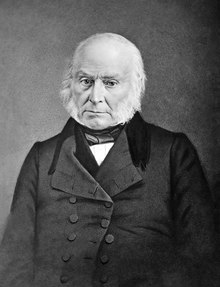
John Quincy Adams
JQA Photo.tif

6th President of the United States
In office
March 4, 1825 – March 4, 1829
Vice President John C. Calhoun
Preceded by James Monroe
Succeeded by Andrew Jackson
Member of the U.S. House of Representatives
from Massachusetts's 8th district
In office
March 4, 1843 – February 23, 1848
Preceded by William B. Calhoun
Succeeded by Horace Mann
Member of the U.S. House of Representatives
from Massachusetts's 12th district
In office
March 4, 1833 – March 3, 1843
Preceded by James L. Hodges
Succeeded by George D. Robinson
Member of the U.S. House of Representatives
from Massachusetts's 11th district
In office
March 4, 1831 – March 3, 1833
Preceded by Joseph Richardson
Succeeded by John Reed Jr.
8th United States Secretary of State
In office
September 22, 1817 – March 4, 1825
President James Monroe
Preceded by James Monroe
Succeeded by Henry Clay
United States Envoy to the United Kingdom
In office
June 8, 1815 – May 14, 1817
President James Madison
James Monroe
Preceded by Jonathan Russell (1812)
Succeeded by Richard Rush
United States Minister to Russia
In office
November 5, 1809 – April 28, 1814
President James Madison
Preceded by William Short
Succeeded by James A. Bayard
United States Senator
from Massachusetts
In office
March 4, 1803 – June 8, 1808
Preceded by Jonathan Mason
Succeeded by James Lloyd
United States Minister to Prussia
In office
December 5, 1797 – May 5, 1801
President John Adams
Thomas Jefferson
Preceded by Position established
Succeeded by Henry Wheaton (1835)
United States Minister to the Netherlands
In office
November 6, 1794 – June 20, 1797
President George Washington
Preceded by William Short
Succeeded by William Vans Murray
Personal details
Born July 11, 1767
Braintree, Massachusetts Bay, British America
(now Quincy, Massachusetts, U.S.)
Died February 23, 1848 (aged 80)
Washington, D.C., U.S.
Resting place United First Parish Church
Political party Federalist (1792–1808)
Democratic-Republican (1808–1830)
National Republican (1830–1833)
Anti-Masonic (1833–1838)
Whig (1838–1848)
Spouse(s) Louisa Johnson (m. 17971848)
Children 4, including George, John, Charles
Education Harvard University (BA, MA)
Signature Cursive signature in ink
John Quincy Adams (Listeni/ˈkwɪnzi/;[a] July 11, 1767 – February 23, 1848) was an American statesman who served as a diplomat, United States Senator, member of the House of Representatives, and was the sixth President of the United States from 1825 to 1829. He was a member of the Federalist, Democratic-Republican, National Republican, and later the Anti-Masonic and Whig parties. He was the son of President John Adams and Abigail Adams and thus contributed to the formation of the Adams political family.
Adams shaped U.S. foreign policy using his ardently nationalist commitment to U.S. republican values. As a diplomat, Adams played an important role in negotiating key treaties, most notably the Treaty of Ghent, which ended the War of 1812. As Secretary of State, he negotiated with Britain over the United States' northern border with Canada, negotiated with Spain the annexation of Florida, and drafted the Monroe Doctrine. Historians generally concur that he was one of the greatest diplomats and secretaries of state in American history.[2][3] In his biography, Samuel Flagg Bemis argues that Adams was able to "gather together, formulate, and practice the fundamentals of American foreign-policy – self-determination, independence, noncolonization, nonintervention, nonentanglement in European politics, Freedom of the Seas, [and] freedom of commerce."[4]
Adams was elected president in a close and controversial four-way contest in 1824. As president he sought to modernize the American economy and promote education. Adams enacted a part of his agenda and paid off much of the national debt.[5] However he was stymied time and again by a Congress controlled by opponents, and his lack of patronage networks helped politicians sabotage him. He lost his 1828 bid for re-election to Andrew Jackson. He has been portrayed by recent historians as an exemplar and moral leader during an era of modernization, when new modes of communication spread messages of religious revival, social reform, and party politics, and improved transportation moved goods, money, and people more rapidly.[6]
After leaving office, he was elected as U.S. Representative from Massachusetts in 1830, serving for the last 17 years of his life with greater acclaim than he had achieved as president. Animated by his growing revulsion against slavery,[7] Adams became a leading opponent of the Slave Power. Adams predicted the Union's dissolution over slavery, and in such a case, felt the president could abolish slavery by using his war powers.[8] Historians have in the aggregate ranked Adams as the 21st most successful president.