From Wikipedia, the free encyclopedia
For his grandson with the same name, see John Quincy Adams II.
"Quincy Adams" redirects here. For the rapid transit train station in Quincy, Massachusetts, see Quincy Adams (MBTA station).
| John Quincy Adams | |
|---|---|
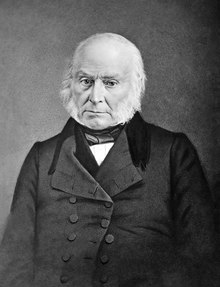 |
|
| 6th President of the United States | |
| In office March 4, 1825 – March 4, 1829 |
|
| Vice President | John C. Calhoun |
| Preceded by | James Monroe |
| Succeeded by | Andrew Jackson |
| Member of the U.S. House of Representatives from Massachusetts's 8th district |
|
| In office March 4, 1843 – February 23, 1848 |
|
| Preceded by | William B. Calhoun |
| Succeeded by | Horace Mann |
| Member of the U.S. House of Representatives from Massachusetts's 12th district |
|
| In office March 4, 1833 – March 3, 1843 |
|
| Preceded by | James L. Hodges |
| Succeeded by | George D. Robinson |
| Member of the U.S. House of Representatives from Massachusetts's 11th district |
|
| In office March 4, 1831 – March 3, 1833 |
|
| Preceded by | Joseph Richardson |
| Succeeded by | John Reed Jr. |
| 8th United States Secretary of State | |
| In office September 22, 1817 – March 4, 1825 |
|
| President | James Monroe |
| Preceded by | James Monroe |
| Succeeded by | Henry Clay |
| United States Envoy to the United Kingdom | |
| In office June 8, 1815 – May 14, 1817 |
|
| President | James Madison James Monroe |
| Preceded by | Jonathan Russell (1812) |
| Succeeded by | Richard Rush |
| United States Minister to Russia | |
| In office November 5, 1809 – April 28, 1814 |
|
| President | James Madison |
| Preceded by | William Short |
| Succeeded by | James A. Bayard |
| United States Senator from Massachusetts |
|
| In office March 4, 1803 – June 8, 1808 |
|
| Preceded by | Jonathan Mason |
| Succeeded by | James Lloyd |
| United States Minister to Prussia | |
| In office December 5, 1797 – May 5, 1801 |
|
| President | John Adams Thomas Jefferson |
| Preceded by | Position established |
| Succeeded by | Henry Wheaton (1835) |
| United States Minister to the Netherlands | |
| In office November 6, 1794 – June 20, 1797 |
|
| President | George Washington |
| Preceded by | William Short |
| Succeeded by | William Vans Murray |
| Personal details | |
| Born | July 11, 1767 Braintree, Massachusetts Bay, British America (now Quincy, Massachusetts, U.S.) |
| Died | February 23, 1848 (aged 80) Washington, D.C., U.S. |
| Resting place | United First Parish Church |
| Political party | Federalist (1792–1808) Democratic-Republican (1808–1830) National Republican (1830–1833) Anti-Masonic (1833–1838) Whig (1838–1848) |
| Spouse(s) | Louisa Johnson (m. 1797–1848) |
| Children | 4, including George, John, Charles |
| Education | Harvard University (BA, MA) |
| Signature |  |
 i/ˈkwɪnzi/;[a]
July 11, 1767 – February 23, 1848) was an American statesman who served
as a diplomat, United States Senator, member of the House of
Representatives, and was the sixth President of the United States from 1825 to 1829. He was a member of the Federalist, Democratic-Republican, National Republican, and later the Anti-Masonic and Whig parties. He was the son of President John Adams and Abigail Adams and thus contributed to the formation of the Adams political family.
i/ˈkwɪnzi/;[a]
July 11, 1767 – February 23, 1848) was an American statesman who served
as a diplomat, United States Senator, member of the House of
Representatives, and was the sixth President of the United States from 1825 to 1829. He was a member of the Federalist, Democratic-Republican, National Republican, and later the Anti-Masonic and Whig parties. He was the son of President John Adams and Abigail Adams and thus contributed to the formation of the Adams political family.Adams shaped U.S. foreign policy using his ardently nationalist commitment to U.S. republican values. As a diplomat, Adams played an important role in negotiating key treaties, most notably the Treaty of Ghent, which ended the War of 1812. As Secretary of State, he negotiated with Britain over the United States' northern border with Canada, negotiated with Spain the annexation of Florida, and drafted the Monroe Doctrine. Historians generally concur that he was one of the greatest diplomats and secretaries of state in American history.[2][3] In his biography, Samuel Flagg Bemis argues that Adams was able to "gather together, formulate, and practice the fundamentals of American foreign-policy – self-determination, independence, noncolonization, nonintervention, nonentanglement in European politics, Freedom of the Seas, [and] freedom of commerce."[4]
Adams was elected president in a close and controversial four-way contest in 1824. As president he sought to modernize the American economy and promote education. Adams enacted a part of his agenda and paid off much of the national debt.[5] However he was stymied time and again by a Congress controlled by opponents, and his lack of patronage networks helped politicians sabotage him. He lost his 1828 bid for re-election to Andrew Jackson. He has been portrayed by recent historians as an exemplar and moral leader during an era of modernization, when new modes of communication spread messages of religious revival, social reform, and party politics, and improved transportation moved goods, money, and people more rapidly.[6]
After leaving office, he was elected as U.S. Representative from Massachusetts in 1830, serving for the last 17 years of his life with greater acclaim than he had achieved as president. Animated by his growing revulsion against slavery,[7] Adams became a leading opponent of the Slave Power. Adams predicted the Union's dissolution over slavery, and in such a case, felt the president could abolish slavery by using his war powers.[8] Historians have in the aggregate ranked Adams as the 21st most successful president.

No comments:
Post a Comment